About the Artist
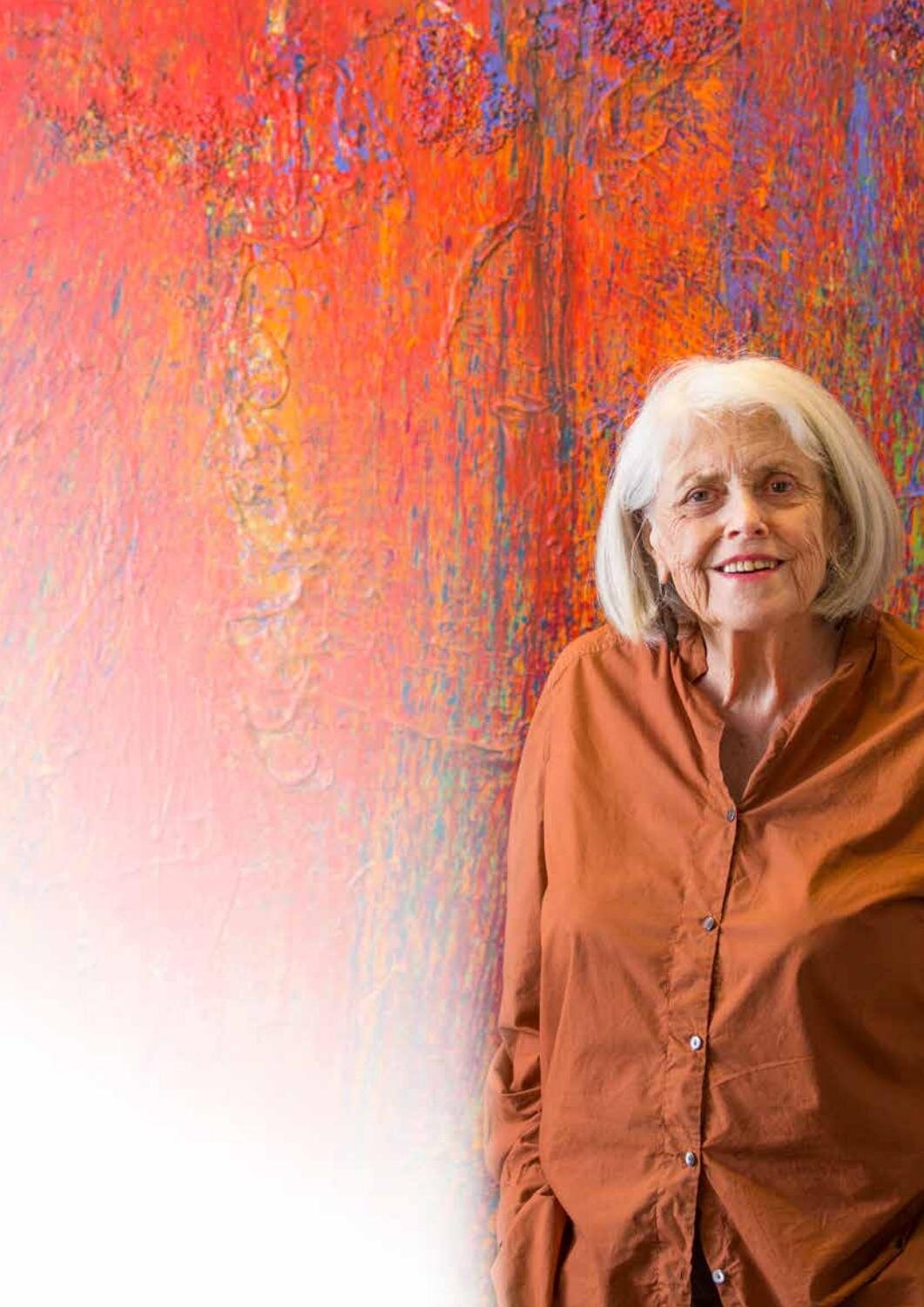
Patricia ‘Pat’ Harry OAM is one of the great characters of Australian painting — a description the Daily Telegraph once made almost literal. Born in 1931 in Bellevue Hill, Sydney, ‘when the trams still ran’, she began studying painting in 1960 at Wollongong Technical College and went on to a career of more than five decades and some fifty solo and group exhibitions, from Wollongong to Bangkok, New York and Canberra.
Her painting has always come from the life around her. In the early years it was the coast — the bright sand, cobalt skies and sunburnt figures of the beach:
“It just came out of me because I lived in the area … the bright colours, the pure colours — and the shapes. They were based on the sea and sky … and legs … lying on the beach looking through people’s legs.”
Her subjects have ranged widely since — large abstract ‘heads’ (‘the people of Sydney; they go into your head’), a Grimms’-fairytale ‘wolves’ series, and journeys into the outback to places like Lake Mungo. She taught for two decades, including as head of a painting workshop at the Canberra School of Art, and was artist-in-residence at Silpakorn University in Bangkok.
At root, though, Pat is an abstractionist. Alongside Matisse and Picasso, her early points of reference were the American Abstract Expressionists — the great colourists Hans Hofmann, Helen Frankenthaler, Barnett Newman and Mark Rothko — and from them she took a freedom of expression that relies on the sheer physical power of paint to carry feeling. In 2000 the National Gallery of Australia acquired her large canvas Gloria II.
In 2017 — the year she was appointed to the Order of Australia (OAM) — Pat packed up a Kings Cross studio of twenty years and moved from Sydney to Eaglehawk, near Bendigo, drawn by an old weeping elm at the front gate and a shed-studio out the back. Her work, she says, changed almost at once: “I’m going back to abstracts. It’s because of the sky — the huge open spaces. I never saw the stars in Sydney.” She has even taken up digital art on an iPad.
She has never had much patience for theory: “Art doesn’t come from theory — it comes from the soul, and from learning the history of art.” Of the move, and of what comes next, she is characteristically undaunted:
“I think retiring is the most devilish thing you can do. It’s another adventure — it might be the most exciting time of my life.”